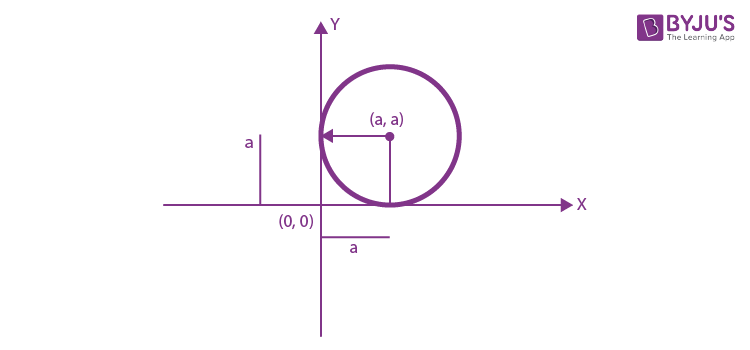
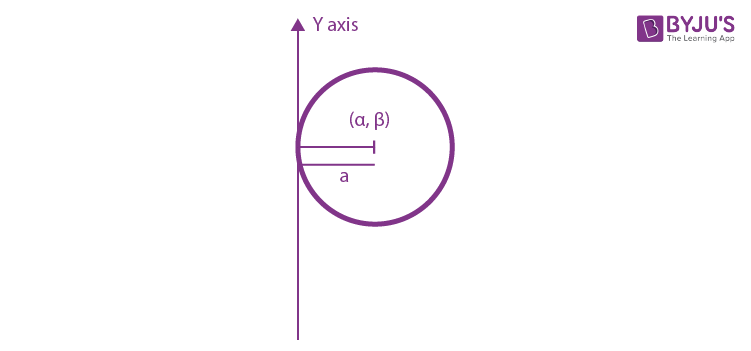
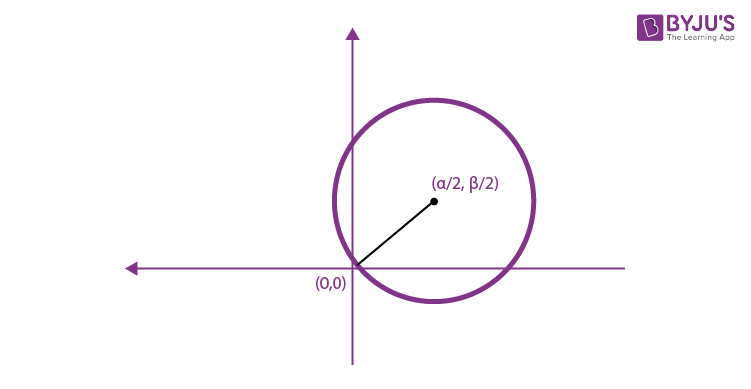
A circle is the locus of points which moves in a plane such that its distance from a fixed point is always constant. The fixed point is called the ‘centre’ while the fixed distance is called the ‘radius’. This article helps you to have a clear idea of the topics such as circle, equation of tangent, normal and chord of contact.
Equation of Circle
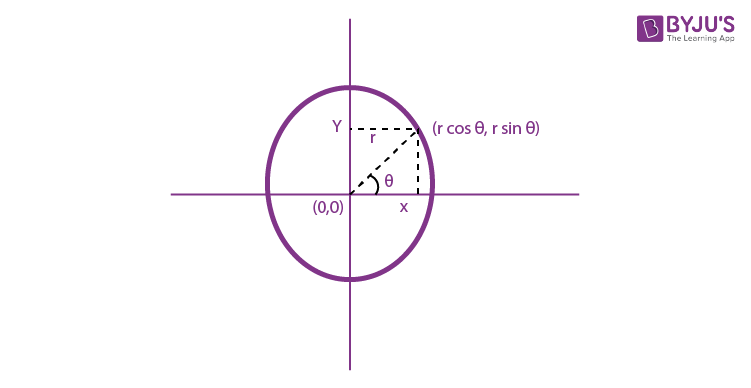
1. Standard Equation of Circle:
x2+y2=r2
centre (0, 0) and Radius (r)
2. Equation of circle in centre radius form:
(x−h)2+(y−k)2=r2
Centre (h, k), Radius = r
3. Equation of circle in General form:
x2+y2+2gx+2fy+c=0
Where (–g, –f ) centre
r2 = g2 + f2 – c .
Radius = g2+f2−c
4. Equation of circle with points P(x1, y1) and Q(x2, y2) as extremities of diameter is
(x – x1) (x – x2) + (y – y1) (y – y2) = 0
5. Equation of circle through three non-collinear points P(x1, y1), Q(x2, y2) and R(x3, y3) is
We rewrite the given equation as x2+y2−38x−310y+1=0⇒g=−34,f=−35,c=1.
Hence the centre is (34,35) and the radius is
916+925−1=932=342.
Illustration 2: Find the equation of the circle with centre (1, 2) and which passes through the point (4, 6).
Solution:
The radius of the circle is (4−1)2+(6−2)2=25=5.
Hence the equation of the circle is
(x−1)2+(y−2)2=25⇒x2+y2−2x−4y=20.
Illustration 3: Find the equation of the circle whose diameter is the line joining the points (-4, 3) and (12, -1). Find also the length of intercept made by it on the y-axis.
Solution:
The required equation of the circle is
(x+4)(x−12)+(y−3)(y+1)=0.
On the y-axis, x=0⇒−48+y2−2y−3=0⇒y2−2y−51=0⇒y=1±52
Hence the length of intercept on the y-axis =252=413.
Illustration 4: Find the equation of the circle passing through (1, 1), (2, -1) and (3, 2).
Solution:
Let the equation be x2+y2+2gx+2fy+c=0.
Substituting the coordinates of the three given points, we get
2g+2f+c=−2,4g−2f+c=−5,6g+4f+c=−13.
Solving the above three equations, we obtain:
f=−1/2;g=−5/2,c=4.
Hence the equation of the circle is
x2+y2−5x−y+4=0.
Illustration 5: Find the equation of the circle whose centre is (3, 4) and which touches the line 5x+12y=1.
Solution:
Let r be the radius of the circle. Then
r = distance of the centre i.e. point (3, 4) from the line 5x+12y=1=∣∣∣∣25+14415+48−1∣∣∣∣=1362.
Hence the required equation of the circle is (x−3)2+(y−4)2=(1362)2⇒x2+y2−6x−8y+169381=0.
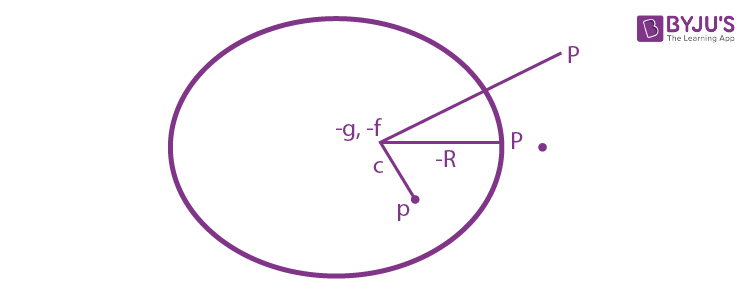
Illustration 6: Find the greatest distance of the point P(10, 7) from the circle x2+y2−4x−2y−20=0.
Solution:
Since S1=102+72−4×10−2×7−20>0, P lies outside the circle.
Join P with the centre C(2, 1) of the given circle.
Suppose PC cuts the circle at A and B, where A is nearer to C.
Then, PB is the greatest distance of P from the circle.
We have, PC =(10−2)2+(7−1)2=10
and CB = radius =4+1+20=5
∴ PB = PC + CB =(10+5)=15
Illustration 7: A foot of the normal from the point (4, 3) to a circle is (2, 1) and a diameter of the circle has the equation 2x−y=2. Then find the equation of the circle.
Solution:
The line joining (4, 3) and (2, 1) is also along a diameter.
So, the centre is the point of intersection of the diameter 2x−y=2 and the line y−3=4−23−1(x−4) i.e., x−y−1=0.
Solving these, we get the centre as (1, 0).
Also, the radius = the distance between (1, 0) and (2, 1) =2
Hence, the equation of circle is (x−1)2+(y−0)2=2or x2+y2−2x−1=0.
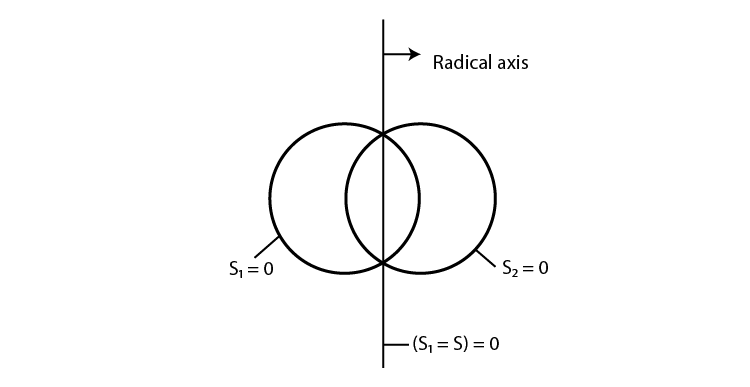
Illustration 8: Find the length of the common chord of the circles x2+y2+2x+6y=0 and x2+y2−4x−2y−6=0
Solution:
Equation of common chord is S1−S2=0 or 6x+8y+6=0 or 3x+4y+3=0.
Centre of S1 is C1(-1, -3) and its radius is 1+9=10..
Distance of C1 from the common chord =9+16∣−3−12+3∣=512
∴ Length of common chord =2(10)2−(512)2=210−25144=225106=52106
Illustration 9: A pair of perpendicular straight lines pass through the origin and also through the point of intersection of the curve with The set containing the value of a is
(a) {-2, 2} (b) {-3, 3} (c) {-4, 4} (d) {-5, 5}
Solution:
To make the curve x2+y2=4 homogeneous with respect to line x+y=a, we should have
Alternating current is a current whose magnitude changes with time, and direction reverses periodically. The alternating emf E at any time is given by the equation : E = E 0 sin ω t The alternating current I at any time is given by : I = I 0 sin ( ω t − ϕ ) Following are a few important terms related to alternating current: Peak Value – Maximum values of voltage and current in a cycle Instantaneous Value – The value of alternating voltage and current at an instant t . Root Mean Square Value – The value of direct current which produces the same heating effect in a given resistor as is produced by the given alternating current when passed for the same time. Mean or average value – It is defined as that value of direct current which sends the same charge in a circuit in the same time as is sent by the given alternating current in its half time period. Question and Answer 1. What is the frequency of a 5μF capacitor that has a reactance of 1000 Ω? ...
Chlorine gas (Cl 2 ) is yellow-green in colour. It is a highly reactive and strong oxidising agent. Chlorine is a member of the 17th group in the periodic table and commonly known as halogens together with other elements such as F, Br, I, etc. Chlorine is mostly found in nature as ionic chloride, e.g. sodium chloride (table salt). Chlorine gas is used as a bleaching agent in the paper and cloth manufacturing industries. It is also used as a disinfectant to kill harmful bacteria in swimming pools and drinking water. 1. Which among the following is the strongest oxidising agent? (a) F 2 (b) I 2 (c) Br 2 (d) Cl 2 Answer: (a) 2. Calcium chlorite has the molecular formula (a) Ca(ClO 4 ) 2 (b) Ca(ClO 3 ) 2 (c) CaClO 2 (d) Ca(ClO 2 ) 2 Answer: (d) 3. Four lone pairs of electrons are present in (a) O (b) He (c) Cl – (d) HI Answer: (c) 4. Which of the following will most readily form an anion? (a) Alkali metals (b) Halogens (c) Nitrogen family (d) Oxygen family Answer: (b) 5. Chlorine is ...



Comments
Post a Comment